

10 B2B Marketing Trends Shaping 2026
Estimated Read Time: 5 minutes
Intended Audience: Digital Marketers, B2B Marketers, Tech Marketers
Every year, there seems to be a new wave of terminology, frameworks, and “next big things.” In 2025, acronyms like AEO, GEO, ABX, LLMO, and AIO dominated conversations, some bringing real value and others adding more noise. With AI accelerating change across nearly every part of marketing, it has become harder to distinguish long-term shifts from short-lived trends. Drawing from what we’ve seen, tested, and refined over the past year, we’re sharing our marketing forecast for 2026.
B2B Marketing Trend #1: Seamless Customer Experience Is the Next Competitive Advantage
In the past, marketing teams have optimized individual channels, email, search, social, events, each in isolation. But buyers don’t experience brands in channels. They experience them as a single journey.
In 2026, the companies that outperform won’t be the ones with the most channels or the biggest budgets. They’ll be the ones that deliver the least friction.
An example of this in practice is our work with Long View, a leading Microsoft Cloud Solution Provider. Aiming to expand their presence and establish a strong lead nurturing strategy, Long View looked to Maven Collective Marketing for our expertise in Microsoft Partner marketing. We provided a strategic marketing plan that prioritized a seamless multi-channel customer experience, which led to $14.5M open pipeline revenue in 4 months and 16% MQL to SQL Conversion Rate.
B2B Marketing Trend #2: Is GEO the New SEO?
GEO has taken the spotlight from SEO, but that doesn’t mean SEO is going away. Instead, it signals a broader shift in how and where people search for information. As more users turn to AI tools to ask questions and research solutions, brands need to expand their visibility strategies beyond traditional search engines. Generative Engine Optimization (GEO) focuses on making content clear, credible, and easily understood by AI systems so it can be surfaced accurately in AI-generated responses.
This change is less about replacing SEO and more about expanding the definition of search. In 2026, brands that invest in both SEO and GEO will be better positioned to stay visible while supporting a more seamless buyer experience.
B2B Marketing Trend #3: Differentiating Your Brand through Authenticity
With AI accelerating content production, the risk of homogenization is real. Messaging can blur together, and solutions often sound interchangeable. Audiences are noticing this shift and increasingly gravitating toward brands that feel human and genuine.
The brands that stand out in 2026 will be those that combine AI efficiency with authentic perspective. The goal is not to replace human insight, but to amplify it. When AI is used strategically and guided by a strong brand identity, it can enhance storytelling rather than dilute it.
B2B Marketing Trend #4: Account-Based Experience (ABX)
Think of ABX as the evolution of ABM. If account-based marketing and customer experience were combined, the result would be a more holistic, account-wide strategy focused on consistency and relevance. In 2026, ABX moves beyond isolated campaigns to deliver coordinated experiences across marketing, sales, and customer success. With buyers overwhelmed by choices and messaging, brands that align every interaction to the needs of their target audience will stand out.
In practice, ABX starts with deep insight into each target account, using CRM data, behavioral signals, and intent indicators. Messaging is coordinated across teams, and campaigns are tailored to the collective priorities of multiple stakeholders. The result is a more intentional experience that builds trust and drives long-term engagement.
B2B Marketing Trend #5: AI Automation for Higher Productivity
If 2025 was the year of experimenting with AI, 2026 will be the year of fully adopting it. AI capabilities are advancing quickly, and what once felt experimental is now becoming embedded in everyday workflows.
Many marketing platforms now include AI-driven features, and for organizations using Microsoft 365, Copilot is increasingly integrated across applications. AI agents are also becoming more capable of handling repetitive tasks, freeing teams to focus on higher-value work.
As a result, strategic thinking will carry more weight than execution alone. Learning how to work alongside AI, rather than around it, will be an essential skill for marketing teams moving forward.
B2B Marketing Trend #6: AI for Content Creation
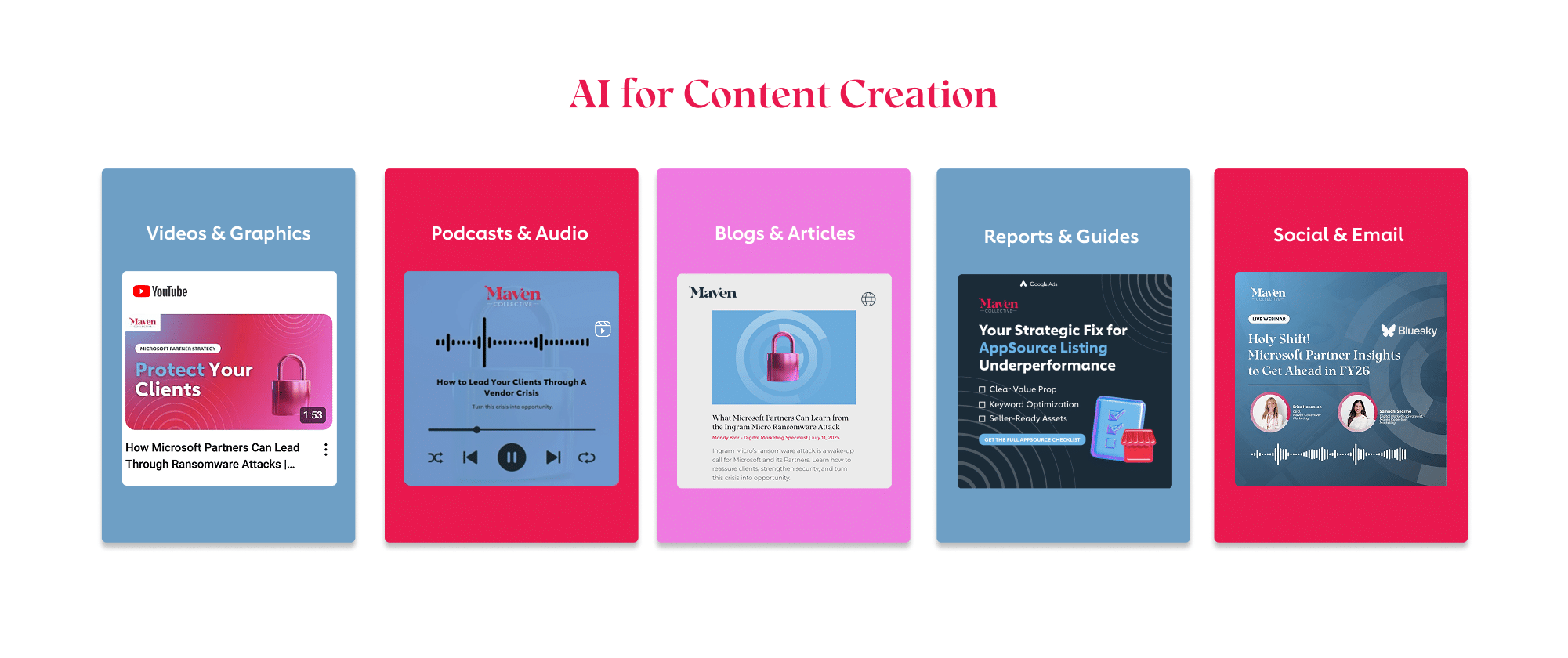
Alongside automation, AI is reshaping how content is created and repurposed. Drafting copy, generating visuals, editing video, and repurposing assets across channels is becoming faster and more accessible.
Over the past year, our team has spent significant time experimenting with AI for content creation. Through this process, we’ve refined our workflows to use AI as a creative accelerator while maintaining brand identity and visual standards. Today, AI is integrated across our graphic, video, and audio production.
For organizations looking to apply AI more strategically, our AEO and Multi-Channel AI Campaign Package is designed to improve visibility in AI-driven search while enabling efficient content repurposing at scale.
B2B Marketing Trend #7: First-Party Data for a Personalized Strategy
As personalization becomes more expected, the role of data becomes more critical. First-party data is becoming the foundation for smarter, more intentional marketing decisions. Rather than relying on third-party signals, organizations are using their own data to understand how audiences interact with their brand and which content resonates most. This enables more relevant experiences while maintaining greater control over data quality.
At the same time, data usage is under closer scrutiny. With AI playing a larger role in personalization, ethical data practices and transparency around collection, storage, and usage are becoming increasingly important. In 2026, compliance and trust will be just as important as performance.
B2B Marketing Trend #8: Content Format Shift to Shorter, Interactive, and Experiential
Attention spans may be shrinking, but that doesn’t mean audiences want less value. Instead, they want information delivered in more engaging and efficient formats.
Short-form, visual, and interactive content is becoming the standard. Explainer videos, product demos, interactive tools, and customer testimonials allow audiences to quickly understand value without unnecessary friction. Brands that embrace these formats in 2026 will be better equipped to capture attention and leave a lasting impression.
B2B Marketing Trend #9: Building Trust through Community Building
People trust people more than they trust brands. In 2026, one of the most effective ways to build trust is by actively participating in the communities your audience already values.
Whether through communities, professional groups, or niche networks, brands that engage authentically can build meaningful conversations and peer-driven advocacy. Community-driven engagement strengthens credibility, encourages word-of-mouth, and creates relationships that extend beyond traditional marketing channels.
B2B Marketing Trend #10: Establishing Authority through Proof and Data-Backed Results
As buying journeys grow more complex, buyers are becoming far more selective about who they trust. In 2026, credibility will be built through evidence, not bold claims or promises. Decision-makers want to see how strategies perform in the real world and what results were achieved.
Brands that consistently share case studies, original research, benchmarks, and measurable outcomes will be better positioned to earn trust and authority. Data-backed storytelling helps buyers connect insight with impact, making it easier to evaluate options and feel confident in their decisions. Over time, this approach does more than support sales conversations. It strengthens thought leadership, attracts media attention, and reinforces long-term visibility, creating a compounding effect that extends well beyond a single campaign.
Craft a Strong B2B Marketing Strategy for 2026
As the marketing forecast continues to evolve, the challenge is no longer keeping up with every new trend. It’s knowing which trends truly matter for your business and how to apply them in a way that creates meaningful impact. The trends shaping 2026 point toward a more connected, intentional approach to marketing, one that prioritizes experience, credibility, and long-term value over short-term tactics.
At Maven Collective Marketing, we help Microsoft Partners translate these trends into practical, results-driven strategies. From creating seamless customer journeys to leveraging data and AI, our focus is on building marketing programs that support sustainable growth. If you’re looking to move beyond experimentation and into execution, we’re here to help you. Contact us today and let’s build a future-ready marketing strategy that delivers lasting results.


